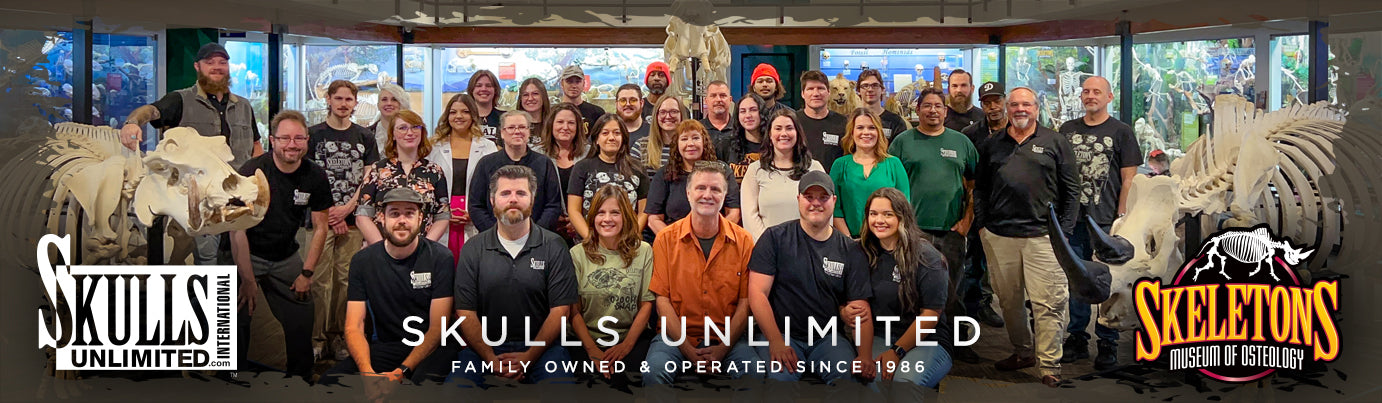
Skulls Unlimited processes thousands of skulls yearly for hunters, professionals, and educators.
Learn more!
Skulls Unlimited and the Museum of Osteology have been featured in newspapers, television programs, podcasts, and educational media around the world. Below is a selection of coverage from journalists and producers who came to us to learn about the science of bones — and left with a very different view of the natural world.
Reporters followed the journey of a white-tailed deer skull from a Michigan hunting camp through the processing lab and into a university anatomy classroom — exploring what ethical sourcing really looks like in the osteological trade.
"The skull is the most information-dense object in nature," says founder Jay Villemarette. Smithsonian's natural history correspondent spent a week at the processing facility and emerged convinced that osteology is one of the most underappreciated sciences in the world.
BBC Science Focus explored the natural history of the flesh-eating beetle and how Skulls Unlimited has turned a museum technique into an industrial-scale cleaning operation that serves clients on six continents.
A deep-dive into how a small Oklahoma City company became the world's go-to supplier for osteological specimens — shipping to Harvard Medical School, the Smithsonian, and private collectors in 50 countries.
Wired's annual "What Humans Do Better Than Machines" feature spotlighted the deeply human expertise required to evaluate, source, and prepare natural bone specimens — a process that defies automation.
As natural history museums face budget pressure and collection access restrictions, researchers increasingly turn to commercial suppliers like Skulls Unlimited for study specimens. Science News examined what this shift means for the future of comparative anatomy research.
Atlas Obscura named the Museum of Osteology one of "America's Most Underrated Museums" — a 6,000-square-foot space packed with hundreds of complete skeletons from every corner of the animal kingdom, where nothing is behind glass and everything can be touched.
The Guardian took a thorough look at the ethics of the natural bone market, speaking with wildlife regulators, conservation biologists, and Skulls Unlimited's legal compliance team. The conclusion: done right, the trade creates incentives to report and recover — rather than waste — animal remains.
We welcome journalists, documentary filmmakers, and content creators. Our team is available for interviews, facility tours, and on-camera demonstrations. We have hosted crews from networks and publications across North America, Europe, and Asia.
To arrange a visit or request a comment, please contact us:
We ask that all media requests be made at least two weeks in advance so we can prepare appropriately and give your project the time it deserves.